
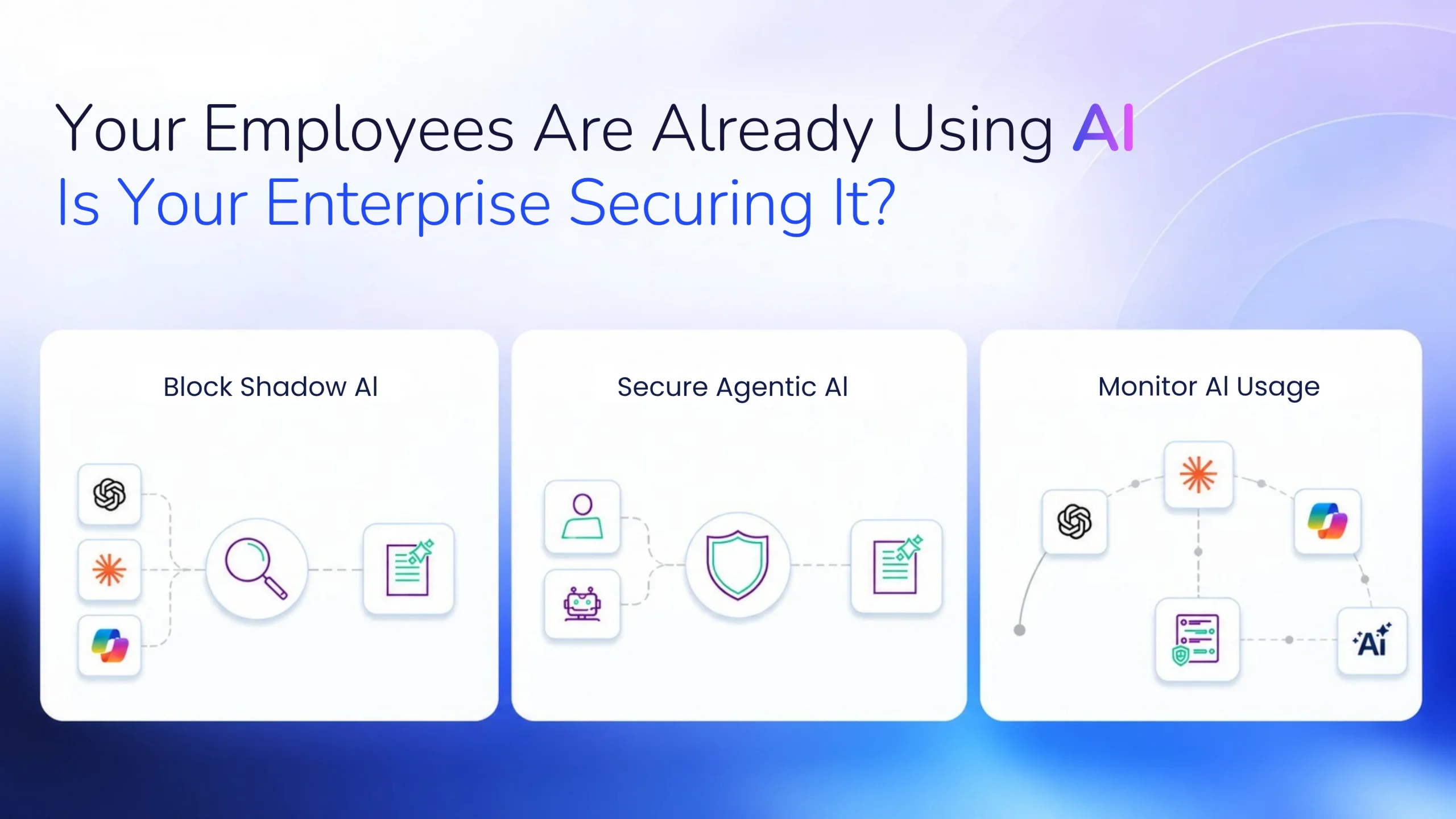
Shadow AI, autonomous agents and uncontrolled data exposure are creating a new set of cybersecurity challenges. Here’s how enterprises can regain visibility and control without slowing innovation.
Artificial intelligence is becoming part of everyday work.
Employees are using AI assistants to draft proposals, summarize documents, analyze spreadsheets and generate code. Business teams are experimenting with AI-powered applications, while IT departments are introducing intelligent copilots and autonomous agents to improve efficiency.
But there is a growing disconnect.
AI adoption is moving faster than the security policies designed to govern it.
An employee might upload a confidential document to an unapproved AI application. An AI agent could access sensitive business systems with permissions broader than necessary. A security team may have limited visibility into which AI tools are being used, what information is being shared and where that information is going.
These are no longer isolated technology concerns. They are enterprise data security and governance challenges.
For CIOs and CISOs, the priority is not to stop AI adoption. It is to make AI adoption secure, visible and controlled.
Three AI Security Priorities Every Enterprise Must Address
Priority 01
Shadow AI: You Cannot Secure What You Cannot See
Shadow AI refers to AI applications and services used by employees without formal IT or security approval.
Consider a common situation.
A finance employee uploads a spreadsheet containing sensitive financial information to an AI tool for analysis. A sales executive uses an unapproved AI assistant to summarize customer discussions. A developer pastes proprietary source code into an external coding assistant.
The objective may be productivity. The security implications can be significant.
Sensitive information may move beyond approved enterprise environments, potentially exposing organizations to data leakage, confidentiality breaches and compliance risks.
The challenge is that traditional application inventories and security controls may not provide sufficient visibility into every AI interaction.
What Enterprises Should Do
✓Discover AI Usage
Identify approved and unapproved AI applications across enterprise environments.
✓Assess Application Risk
Evaluate data handling, retention, access permissions and security practices.
✓Classify Sensitive Information
Understand which business data should never be shared with external AI systems.
✓Enforce Risk-Based Policies
Allow, restrict or block AI interactions based on application risk and data sensitivity.
✓Offer Approved Alternatives
Provide employees with secure AI tools that meet their productivity needs.
The goal should not be indiscriminate blocking. It should be enabling responsible AI adoption through visibility and appropriate controls.
Priority 02
Agentic AI: When AI Can Take Action, Security Must Go Beyond Access
AI assistants primarily help employees generate information. Agentic AI goes further.
Autonomous or semi-autonomous AI agents can interact with enterprise applications, retrieve information, execute workflows and initiate actions across connected systems.
An AI agent may have permission to update customer records, create IT service requests, retrieve financial information or trigger automated business processes.
An AI assistant that generates an incorrect answer creates one type of risk. An AI agent that executes an unauthorized action creates another.
As organizations adopt agentic workflows, several new questions emerge.
- What systems can the agent access?
- What permissions does it inherit?
- Can it execute sensitive actions without approval?
- What happens if malicious instructions manipulate its behavior?
- Can every action be traced back to a user, agent and authorization?
Agentic AI also introduces risks associated with tool integrations, including those using the Model Context Protocol (MCP), a standard for connecting AI applications to external tools and data sources.
Securing these environments requires controls that extend beyond traditional user authentication.
What Enterprises Should Do
✓Apply Least-Privilege Access
Give agents only the permissions necessary for their tasks.
✓Maintain Agent Inventories
Know which agents exist, who owns them and which systems they can access.
✓Introduce Human Approvals
Require explicit authorization for sensitive or high-impact actions.
✓Secure Tool Integrations
Validate connected tools, permissions, credentials and execution boundaries.
✓Maintain Audit Trails
Record agent activity, tool calls, approvals and policy decisions.
✓Monitor Abnormal Behavior
Detect unusual access patterns, unauthorized actions and possible manipulation.
The underlying principle is straightforward: AI agents should operate within clearly defined boundaries, with accountable human oversight.
Priority 03
AI Usage Monitoring: Visibility Must Extend to Data, Users and Actions
Even approved AI applications can introduce security risks.
An organization may authorize enterprise AI assistants, integrate AI into internal workflows and implement approved models. But approval alone does not establish continuous security.
Security teams still need to understand how AI applications are being used, what information is being processed and whether user or agent activities comply with enterprise policies.
For example, a sanctioned AI assistant may retrieve confidential files from an enterprise repository. Whether this creates a security incident depends on the user’s permissions, the sensitivity of the information and how the data is subsequently handled.
This is where continuous AI usage monitoring becomes essential.
What Enterprises Should Do
✓Establish AI Usage Visibility
Monitor authorized applications, users, access patterns and relevant agent activities.
✓Protect Sensitive Information
Apply data classification and Data Loss Prevention (DLP) controls to AI interactions.
✓Enforce Consistent Policies
Align AI security with existing data protection, identity and access governance policies.
✓Investigate Risky Behavior
Identify unusual uploads, excessive access and potential data exposure.
✓Support Audits and Compliance
Maintain appropriate records of access, actions and policy enforcement.
Effective monitoring must also respect employee privacy, data minimization requirements and applicable regulations.
The objective is not to monitor every employee conversation indiscriminately. It is to identify security risks and protect sensitive business information.
AI Security Is Not Another Isolated Technology Project
Many enterprises already operate multiple security solutions, including endpoint protection, identity management, DLP, SIEM, cloud security and access controls.
The answer to AI security is not necessarily another disconnected tool.
The bigger opportunity is to extend existing security architecture to account for AI applications, autonomous agents and new patterns of data movement.
This requires coordination across cybersecurity, IT operations, data governance and business teams.
Three Capabilities for a Practical AI Security Strategy
01 / Discover
Know Your AI Environment
Understand where AI is being used, which applications and agents are active, and what sensitive data they can access.
02 / Control
Enforce Appropriate Security Policies
Apply identity, data protection, access and approval policies appropriate to the risks involved.
03 / Monitor
Continuously Evaluate AI Activity
Continuously evaluate AI interactions, detect policy violations and respond to emerging threats.
Together, these capabilities can help organizations move from fragmented AI adoption to more secure, governed and scalable AI operations.
Where Should Enterprises Begin?
A complete AI security transformation does not have to happen overnight.
Organizations can start with a focused assessment of their current exposure and progressively strengthen controls.
| Priority | Recommended Action |
|---|---|
| AI discovery | Identify sanctioned and unsanctioned AI tools and agents |
| Data risk assessment | Map sensitive information and potential AI-related exposure |
| Access governance | Review permissions, integrations and high-risk agent actions |
| Security policy | Define acceptable AI usage and data handling requirements |
| Continuous monitoring | Integrate relevant AI security signals into existing security operations |
This approach helps security leaders prioritize the highest risks while supporting the organization’s broader AI ambitions.
From AI Adoption to Secure AI Operations
Artificial intelligence will continue to become more deeply integrated into enterprise workflows.
As that happens, the traditional boundaries between users, applications, data and automated actions will become increasingly complex.
Organizations need to move beyond asking whether AI tools are approved.
They need to ask whether those tools can be monitored, whether sensitive data remains protected and whether autonomous actions operate within acceptable security boundaries.
The Way Forward
The future of enterprise AI security is not about choosing between innovation and control. It is about making secure innovation possible.
How Progressive Techserve Can Help
At Progressive Techserve, we help enterprises strengthen their cybersecurity posture through security assessments, implementation, integration and managed security services.
Our approach to AI security focuses on aligning emerging AI risks with established enterprise security practices, including data protection, identity and access controls, security monitoring and governance.
From evaluating AI-related data exposure to integrating appropriate security controls into existing environments, we help organizations develop practical strategies for adopting AI more securely.
✓AI Security Readiness
Assess AI adoption, visibility gaps, sensitive data exposure and security governance priorities.
✓Data Protection & Access Governance
Strengthen data protection, identity management, access controls and policy enforcement across enterprise environments.
✓Security Monitoring & Managed Services
Integrate relevant security signals into existing monitoring and incident response processes to help identify and investigate risks.
✓AI Governance & Risk Management
Develop practical governance strategies for responsible AI adoption, policy alignment and ongoing risk management.
Secure Your AI Journey
Looking to Strengthen Your Enterprise AI Security Posture?
Connect with Progressive Techserve to discuss an AI security readiness assessment and identify priority areas for improving visibility, protecting sensitive data and governing AI-driven workflows.
Talk to Our Cybersecurity ExpertsProgressive Techserve • AI-Augmented | Human-Led