
India has launched a new portal under its Digital Personal Data Protection (DPDP) framework. But does every business need to register? What is a Consent Manager? And what do terms like RoPA, Data Fiduciary and Consent Management actually mean? Here’s a simple guide.
India has taken another step towards implementing its new data privacy law.
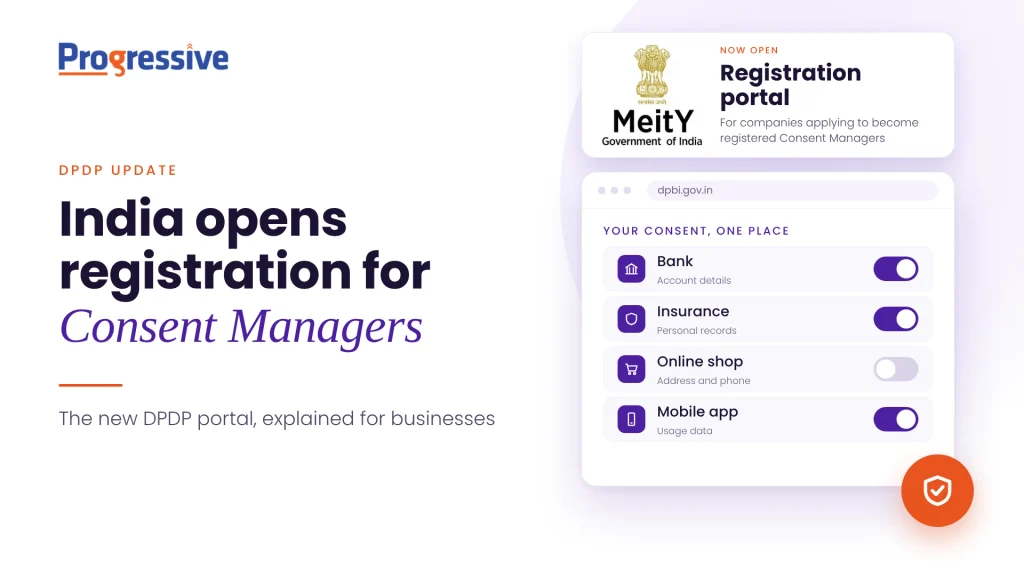
On 13 November 2026, the government’s framework for registering Consent Managers came into effect. The Ministry of Electronics and Information Technology (MeitY) also launched a new online registration portal at dpbi.gov.in.
The announcement is important, but it has also created some confusion.
Does this mean every company needs to register on the portal? Is a Consent Manager the same as consent management software? Are businesses expected to comply with the entire DPDP Act immediately?
1 First, What Exactly Has the Government Launched?
The government has launched an online portal where eligible Indian companies can apply to become registered Consent Managers.
A Consent Manager is an independent service that helps individuals manage permissions for how their personal information is used.
Think about how many companies have your personal information today.
- Your bank has your financial details.
- An e-commerce platform has your address.
- An insurance company has your personal records.
- A mobile application may have access to other information.
You may have agreed to share this information at different times, but remembering and managing those permissions isn’t easy.
A registered Consent Manager is intended to make that process simpler.
Through its platform, individuals will be able to give, review, manage and withdraw consent across participating organisations.
Companies applying to become registered Consent Managers must meet specific eligibility conditions, including a minimum net worth of ₹2 crore.
2 What Does the DPDP Act Actually Mean?
The Digital Personal Data Protection Act, 2023 is India’s framework for protecting people’s digital personal information.
In simple terms, it is about three things:
For example, suppose you give an online shopping company your phone number to deliver a product.
That does not automatically mean the company can use your number for every other purpose.
The organisation needs an appropriate legal basis for how it uses that information, such as valid consent or another use permitted under the Act.
The law is designed to make those responsibilities clearer.
3 Confused by All the DPDP Terminology? Here’s What It Actually Means.
One of the biggest challenges with DPDP is the language.
Data Principal. Data Fiduciary. RoPA. DPIA. Consent Manager. Consent Management Platform.
They sound complicated, but most describe everyday business activities. Here’s a practical dictionary.
| Term | What It Means in Simple English |
|---|---|
| Data Principal | The individual whose personal information is being used. For example, your customer or employee. |
| Data Fiduciary | The organisation that decides why and how personal information is used. For example, a bank or employer. |
| Data Processor | A company that processes information on behalf of another business. For example, a payroll provider handling employee salaries. |
| Consent Manager | An independent, officially registered service that helps individuals give, manage, review or withdraw consent through a common platform. |
| Consent Management Platform (CMP) | A software tool businesses can use to collect, record, track and manage customer consent and withdrawals. This is different from a registered Consent Manager. |
| RoPA (Record of Processing Activities) | A structured record showing what personal information your business uses, why it uses it, where it is stored, who can access it and how long it is retained. |
| Data Mapping | Finding where personal information exists and how it moves across applications, departments, vendors and systems. |
| Privacy Notice | A clear explanation given to individuals about what information is collected, why it is needed and how they can exercise their rights. |
| Consent Record | Evidence of what someone agreed to, when they agreed, and what information or purpose the agreement covered. |
| DPIA (Data Protection Impact Assessment) | A structured assessment of privacy risks associated with processing personal information and how those risks will be managed. |
| DPO (Data Protection Officer) | A person responsible for specified data protection functions. Under DPDP, designated Significant Data Fiduciaries must appoint one. |
| Significant Data Fiduciary (SDF) | An organisation specifically designated by the government because of factors such as the scale, sensitivity or risks of its data processing. |
| Data Retention | Deciding how long personal information should be kept and when it must be deleted, subject to applicable legal requirements. |
| Data Breach | A security incident involving unauthorised access, disclosure, loss, alteration or other compromise of personal information. |
| Grievance Redressal | A process through which individuals can raise complaints or concerns about how their personal information is handled. |
| Data Erasure | Deleting personal information when it is no longer needed or when deletion is required under applicable rules. |
4 Consent Manager vs Consent Management Tool: What’s the Difference?
This is probably one of the most misunderstood aspects of DPDP.
Although the names sound almost identical, they serve different purposes.
Consent Manager
A Consent Manager is a regulated service registered with the Data Protection Board of India.
Its role is to help people manage their consent across organisations connected to its platform.
For example, an individual could use a Consent Manager to review permissions involving two participating financial institutions.
Consent Management Platform
A Consent Management Platform is software used by an organisation to manage the consent it collects from its own customers or users.
For example, imagine an insurance company with 50,000 customers.
It may need to understand which customers have agreed to marketing communications, when permissions were collected, what each customer agreed to and whether someone has withdrawn consent.
A consent management tool can help the company automate and maintain records of these activities.
And importantly, purchasing a Consent Management Platform is not automatically mandatory for every business under DPDP, nor does purchasing one guarantee compliance.
5 What About RoPA? Why Are Companies Talking About It?
RoPA stands for Record of Processing Activities.
It sounds technical, but think of it as an inventory of how your organisation uses personal information.
For example, an HR department might use employee data across several systems.
| Business Activity | Personal Information Involved | Where It Is Used |
|---|---|---|
| Payroll | Name, bank details, salary | Payroll software |
| Recruitment | CV, email, phone number | Applicant tracking system |
| Employee Attendance | Employee ID, attendance records | HRMS |
| Customer Support | Customer contact details, tickets | CRM or helpdesk |
A RoPA adds more detail, such as the purpose of processing, data recipients, retention periods and security arrangements.
Why does it matter?
Because before you can protect information, you need to know what you have and where it goes.
Many businesses have personal information scattered across departments, cloud applications, spreadsheets and external service providers.
Data mapping helps discover that information. RoPA helps organise the findings into a structured record.
6 Does Every Company Need a DPDP Compliance Platform?
Not necessarily.
The DPDP framework sets out legal obligations. It does not say every company must purchase one particular compliance product.
A smaller organisation with limited data-processing activities may be able to manage some requirements through established internal processes.
A large organisation handling customer and employee information across dozens of systems may benefit from software to automate tasks such as:
- Consent collection and tracking.
- Data discovery and mapping.
- Privacy notices and consent records.
- Handling requests to access, correct or erase personal data.
- Retention and deletion workflows.
- Monitoring third-party data processing.
- Managing privacy incidents and reporting workflows.
The right approach depends on the type and volume of personal information a business handles, the purposes for which it uses that information, its legal obligations and its existing technology.
7 When Do Businesses Actually Need to Comply?
The government has introduced the DPDP framework in phases.
13 November 2025 — Initial Implementation
The first provisions of the Act and Rules came into effect, establishing the initial legal and administrative framework.
13 November 2026 — Consent Manager Registration
The framework for registering Consent Managers became effective, with a new portal for eligible applicants.
13 May 2027 — Major Compliance Provisions
Key requirements relating to business responsibilities, individuals’ rights, security safeguards and the Board’s enforcement processes are scheduled to take effect.
The Data Protection Board has been legally established, although appointments to its leadership and membership were still pending when the registration portal was launched.
This phased approach gives businesses time to prepare.
But for organisations with thousands of employees, customers, vendors and multiple IT systems, preparing for DPDP can involve significant work.
8 What Should Businesses Do Right Now?
Instead of starting with a software purchase, start with five practical questions.
-
What personal information do we collect?
Identify customer, employee, supplier and other personal information held across your business. -
Where is that information stored?
Look beyond your primary databases. Personal information may exist in cloud applications, CRM systems, HR platforms, email, spreadsheets and vendor environments. -
Why do we collect and use it?
Determine the purpose and legal basis for each processing activity. Identify where valid consent is required. -
How do we manage permissions and individual requests?
Check whether you can record consent, handle withdrawal requests, correct information and delete data when required. -
Can we protect the information and respond to a breach?
Review access controls, security measures, vendor arrangements, incident response and data retention practices.
The answers will help identify gaps before deciding whether new processes, services or technologies are required.
9 The Bottom Line: What Does This Launch Really Mean?
India’s new Consent Manager registration portal is another important step towards implementing the DPDP framework.
But it does not mean every company must register on the portal. Nor does it mean every business needs to purchase a new consent management product immediately.
For individuals, the framework aims to provide greater visibility and control over permissions relating to their personal information.
For organisations, the larger challenge is understanding what personal information they handle, why they need it, how they protect it and how they meet their legal responsibilities.
And that starts with understanding your data, not with understanding every acronym.