
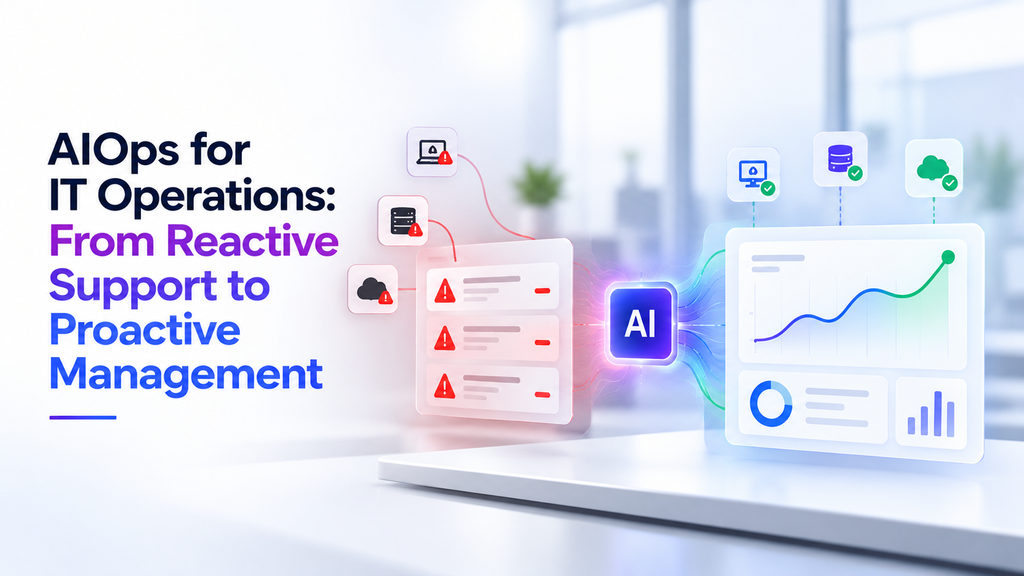
A slow business application can trigger alerts across servers, databases and networks. Yet identifying what went wrong often requires engineers to switch between dashboards, review logs and coordinate across teams. While the investigation continues, employees struggle to work and business operations suffer.
AIOps for IT Operations helps address this challenge by bringing operational data, AI-driven analysis and automation together. It enables IT teams to identify meaningful signals, investigate likely causes and respond with greater speed and consistency.
What Is AIOps for IT Operations?
AIOps stands for Artificial Intelligence for IT Operations. It applies AI and machine learning to operational data, helping teams detect anomalies, correlate events and support incident diagnosis.
By analysing information from monitoring platforms, system logs and service management tools, AIOps can connect events that would otherwise appear unrelated. When integrated with automation, it can also trigger predefined responses to suitable incidents.
For enterprises managing hybrid cloud, data centres and distributed infrastructure, this creates an opportunity to move beyond responding to individual alerts towards understanding service health.
Why IT Teams Need More Than Monitoring
Monitoring tells teams when a threshold has been breached. However, an alert alone may not explain the business impact, the underlying cause or the action required.
Consider an application slowdown accompanied by high database latency and storage performance alerts. Investigating each alert separately can lead to duplicated effort and delayed restoration.
AIOps adds analytical context to these signals. Combined with observability and integrated automation, it helps teams connect detection with action. The value depends on how effectively these capabilities work together within day-to-day operations.
Key Use Cases of AIOps for IT Operations
1. Alert Noise Reduction
A single infrastructure issue can generate multiple downstream alerts. Event correlation helps group related signals, allowing engineers to investigate a connected incident rather than repeatedly reviewing its symptoms.
2. Anomaly Detection
Fixed thresholds do not always capture unusual behaviour. AIOps can use historical patterns to flag deviations in resource consumption, response times or traffic, supporting earlier investigation of potential problems.
3. Faster Incident Diagnosis
By analysing related operational events, AIOps can highlight probable causes and help engineers narrow their investigation. These findings support troubleshooting; they still require validation when evidence is incomplete.
4. Automated Remediation
When connected to an automation platform, AIOps insights can initiate approved runbooks. Potential actions include restarting a failed service or collecting diagnostic information, depending on the environment and defined policies.
The workflow should include checks to confirm whether the action restored service and escalation when it did not.
5. Capacity and Performance Planning
Analysis of utilisation trends can help teams anticipate resource pressure and investigate performance bottlenecks. This supports more informed capacity decisions across applications, hardware and network infrastructure.
How to Put AIOps into Practice
A practical starting point is a recurring operational problem with a measurable business impact. For example, choose an application that frequently slows down or an infrastructure service that generates excessive alerts.
Build the implementation around five questions:
- What needs to improve? Define the target, such as faster restoration or fewer repeat incidents.
- Is the data usable? Check telemetry coverage, timestamps, asset information and service dependencies.
- Who owns the response? Establish incident ownership and escalation paths.
- Which actions can be automated? Start with tested, repeatable workflows and clear approval boundaries.
- How will success be measured? Compare results against the baseline before expanding coverage.
Human oversight should remain central to decisions involving critical systems, uncertain diagnoses or significant operational changes. Engineers should review recommendations, refine runbooks and use incident learnings to improve the approach.
Measure Outcomes That Matter
An AIOps programme should be assessed through operational results. Useful measures include:
- Time taken to detect an incident and restore service.
- Duplicate alerts and recurring incidents.
- Percentage of automated actions completed successfully.
- Manual effort required for routine investigation.
- Availability and performance against agreed service objectives.
Track these measures by service and incident severity. A reduction in alert volume is useful only when teams continue to detect and respond to meaningful problems.
Progressive Techserve’s Approach to AIOps
Progressive Techserve brings together infrastructure managed services, observability, automation and AIOps to support always-on IT operations. Its capabilities span hybrid cloud and data centre management, network operations, database operations and 24×7 monitoring.
Our approach combines AI-assisted detection and diagnosis with engineering expertise and human oversight. Across monitoring, incident response and remediation, the focus is on helping enterprises improve reliability, reduce repetitive operational effort and restore services faster.
For organisations exploring AIOps for IT Operations, the starting point is understanding the existing environment: where visibility is missing, which incidents recur and which responses can be safely automated.
Ready to strengthen your IT operations with AIOps? Contact Progressive Techserve to discuss your infrastructure and automation priorities.