
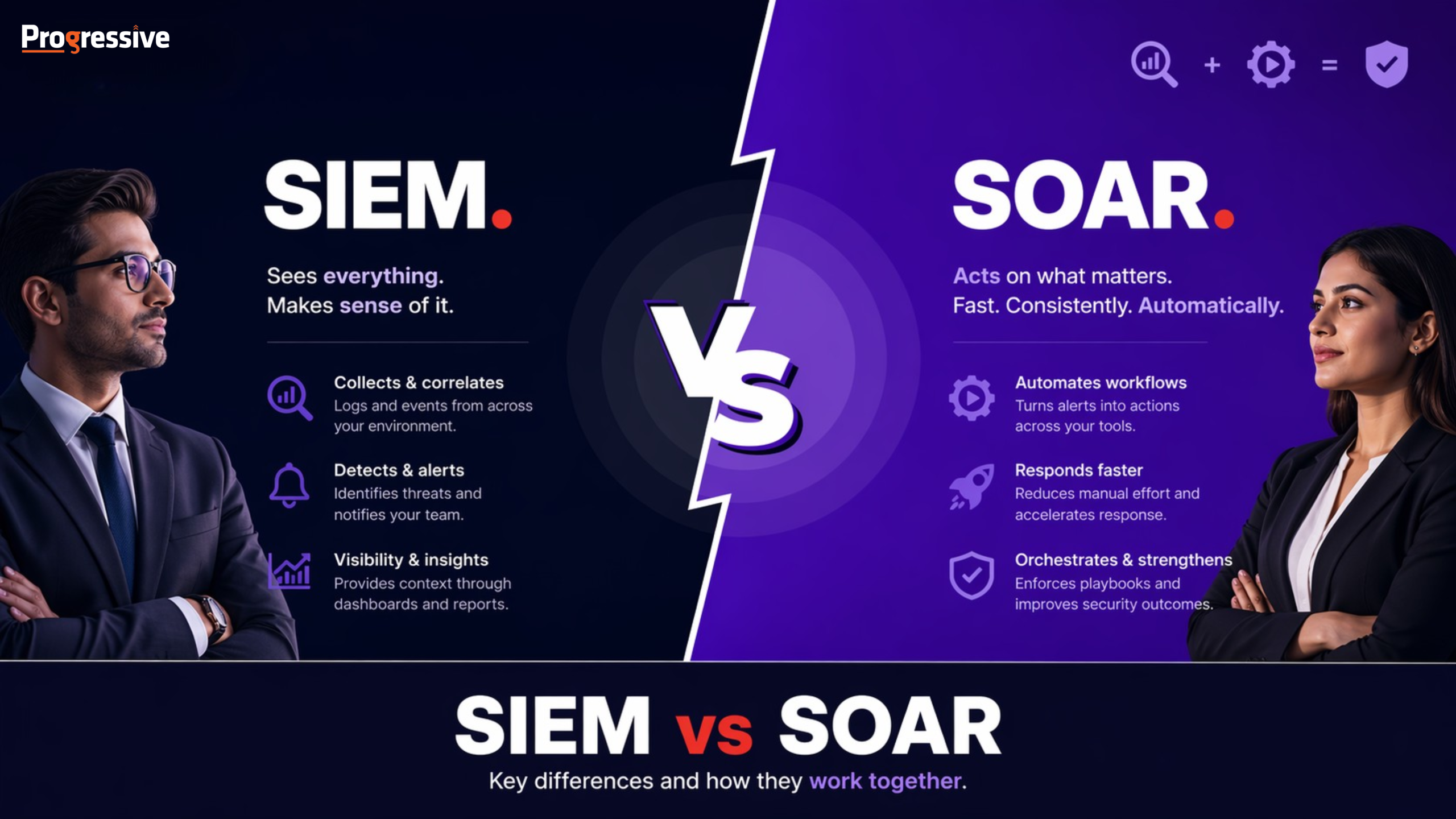
SIEM and SOAR are two of the most frequently referenced tools in enterprise security, and they often appear side by side in conversations about Security Operations Centers. While they are closely related, they serve distinct purposes and address different challenges in the security operations workflow.
Understanding what each tool does individually, and how they function as a pair, is foundational to evaluating any managed security setup — whether you are building an internal SOC or assessing an external provider.
What Is SIEM?
SIEM stands for Security Information and Event Management. It is the central data collection and analysis layer of a SOC. A SIEM pulls in log data and event information from across your entire environment — firewalls, servers, endpoints, cloud services, applications — and brings it all into one
place.
Once the data is collected, the SIEM applies correlation rules to look for patterns across thousands of individual events. An isolated failed login attempt carries little significance on its own, but fifty failed logins across ten accounts within a three-minute window suggests a credential-based attack in progress. The SIEM identifies that pattern and surfaces a prioritised alert for the SOC team to investigate.
Core functions of a SIEM
- Collects logs and event data from network devices, endpoints, applications, and cloud platforms
- Correlates events across different sources to find patterns that indicate something suspicious
- Raises alerts and prioritises them so analysts focus on what matters most
- Stores historical data for investigations and compliance audits
- Generates reports for security reviews and regulatory requirements
What Is SOAR?
SOAR stands for Security Orchestration, Automation, and Response. Where SIEM identifies what is happening, SOAR determines what to do about it and in many cases, does it automatically.
A SOAR platform integrates with the full stack of security tools and executes predefined response playbooks when an alert is received. It can query threat intelligence feeds for context on a suspicious IP, isolate a potentially compromised endpoint, suspend an affected account, create a ticket in the ITSM system, and deliver a structured summary to the on-call analyst, all within seconds of the initial alert.
Core functions of a SOAR
- Receives alerts from the SIEM and other detection tools
- Enriches alerts automatically by pulling context from threat intelligence feeds and asset data
- Runs response playbooks to contain threats, blocking IPs, isolating devices, resetting credentials
- Handles repetitive tier-1 tasks so analysts can focus on complex investigations
- Documents every action taken, which is useful for post-incident reviews and compliance reporting
SIEM vs SOAR: How They Compare
The table below outlines how the two tools differ across the dimensions that matter most in a security operations context:
| SIEM | SOAR | |
|---|---|---|
| Primary function | Detection and alerting | Response and automation |
| Input | Raw logs and events from across the environment | Alerts from SIEM and other security tools |
| Output | Prioritised alerts and compliance reports | Automated actions and enriched incident cases |
| Primary beneficiary | Analysts conducting threat investigations | Analysts managing high alert volumes |
| False positives | Can generate significant alert volume | Filters and reduces alert noise over time |
| Compliance use | Log retention, audit trails | Response documentation, regulatory evidence |
| Without the other | Detects threats but response remains manual | Has no reliable detection data to act on |
How SIEM and SOAR Work Together
Operating a SIEM without SOAR means the SOC team receives alerts but carries out every response step manually. In environments with high event volumes, this creates significant analyst fatigue and leads to slower response times on the incidents that matter most.
Conversely, a SOAR platform without a SIEM has no reliable, correlated data stream to act on. SOAR executes playbooks in response to structured alerts, without a SIEM providing that input, the automation layer has no trigger.
When the two tools are integrated, they create a closed-loop detection and response cycle:
- The SIEM continuously ingests log and event data from across the environment
- Correlation rules identify suspicious patterns and generate a prioritised alert
- The SOAR platform receives the alert and triggers the appropriate response playbook
- Automated enrichment and initial containment steps execute within seconds
- The analyst receives a fully contextualised case, ready for review and closure
- Investigation outcomes are fed back into SIEM rule tuning to improve future detection accuracy
This integrated cycle is what enables a well-run Security Operations Center to achieve consistent, low mean-time-to-detect (MTTD) on high-priority threats. It is also the operational model that underpins mature managed SOC services, where both tools run continuously, tuned and staffed around the clock.
Use Cases: Where SIEM and SOAR Add the Most Value
Understanding where each tool delivers results in practice helps clarify why organisations invest in both.
SIEM use cases
- Insider threat detection: A SIEM correlates user activity across systems — file access, login times, data transfers — and flags deviations from established behavioural baselines. Where a single action may appear routine, a sequence of actions over days or weeks can indicate a threat from within.
- Compliance audit reporting: Regulated industries require detailed, timestamped records of who accessed what, when, and from where. A SIEM maintains these logs centrally and generates structured reports mapped to frameworks such as ISO 27001, DPDPA, PCI DSS, and HIPAA, reducing the manual effort involved in audit preparation.
- Cloud and hybrid environment monitoring: As organisations move workloads across AWS, Azure, and GCP alongside on-premise infrastructure, SIEM platforms ingest logs from all environments into a unified view. This prevents visibility gaps that threat actors routinely exploit.
- Threat intelligence correlation: A SIEM enriches incoming events against known indicators of compromise (IoCs) from threat intelligence feeds, allowing analysts to identify activity linked to active threat campaigns before damage occurs.
SOAR use cases
- Phishing response automation: When a phishing email is reported or detected, a SOAR playbook can automatically extract the sender details and URLs, query them against threat intelligence platforms, block the sender domain at the email gateway, scan for other recipients of the same message, and notify affected users — all without analyst intervention.
- Ransomware containment: On detecting indicators of ransomware activity, a SOAR platform can isolate the affected endpoint from the network, suspend the associated user account, capture a memory snapshot for forensic analysis, and alert the incident response team. Speed of containment directly limits blast radius.
- Credential-based attack response: When a SIEM flags a brute force attempt or account compromise, SOAR automatically resets or suspends the affected credentials, blocks the source IP at the firewall, and opens a prioritised incident ticket, compressing a multi-step manual process into seconds.
- Vulnerability alert triage: SOAR can receive vulnerability scanner output, cross-reference asset criticality and existing patch status, and auto-close low-risk findings, ensuring analysts review only the vulnerabilities that genuinely require human judgment.
How to Choose the Right SIEM and SOAR Platform
Selecting SIEM and SOAR platforms is a significant decision. The tools need to fit the organisation’s environment, team capability, compliance requirements, and long-term security roadmap. The following criteria provide a practical framework for evaluation.
For SIEM selection
- Data source coverage: Confirm the platform supports native connectors for every environment you operate — on-premise, cloud (AWS, Azure, GCP), SaaS applications, and OT/IoT systems if relevant. Gaps in log ingestion create blind spots.
- Scalability and pricing model: SIEM pricing is typically based on data ingestion volume or events per second. Understand how costs scale as your environment grows, particularly if you plan to expand cloud workloads.
- Detection rule library: Evaluate the quality and breadth of out-of-the-box detection rules, and how frequently the vendor updates them to reflect new threat intelligence. A strong baseline reduces the time to initial value.
- Search and investigation capability: Analysts spend significant time investigating alerts. The quality of the query interface, log search speed, and visualisation tools directly affects how efficiently the SOC operates.
- Compliance reporting templates: If you operate under specific regulatory frameworks — DPDPA, ISO 27001, SEBI, HIPAA — check whether the platform includes pre-built compliance report templates or requires custom development.
For SOAR selection
- Integration breadth: A SOAR platform is only as useful as the tools it connects to. Prioritise platforms with pre-built integrations for the security stack you already run — SIEM, EDR, firewall, identity provider, ticketing system, and threat intelligence feeds.
- Playbook development environment: Evaluate how playbooks are authored. Some platforms offer visual, low-code builders; others require scripting. The right choice depends on your team’s technical depth and how quickly you need to build and modify workflows.
- Case management capability: Strong SOAR platforms include built-in case management so analysts can track incidents, document decisions, and maintain a clear audit trail from detection through to closure.
- False positive reduction over time: A SOAR platform should improve with use. Look for machine learning capabilities that tune alert triage over time, reducing noise as the system learns your environment.
- Vendor ecosystem and support: For organisations that use a primary security vendor like Microsoft, Palo Alto, IBM, or Splunk, evaluating the native SOAR offering within that ecosystem may reduce integration complexity and total cost.
Frequently Asked Questions
Some platforms bundle both capabilities together. Progressive Techserve is a common example, it handles log collection, correlation, and automated response in one product. Whether to use a bundled platform or best-of-breed tools for each function depends on the size and complexity of your environment. Most enterprise-grade SOC setups use dedicated tools that are tightly integrated.
The need exists regardless of organisation size, though the implementation approach may differ. Smaller security teams typically benefit significantly from SOAR automation because they have fewer analysts to manage alert volumes manually. A managed SOC service that includes both capabilities is often more operationally practical for mid-sized organisations than maintaining two separate licensed platforms
in-house.
EDR (Endpoint Detection and Response) focuses on monitoring and responding to threats at the individual device level. SOAR operates at a broader layer — it receives alerts from EDR tools alongside the SIEM, firewall, identity systems, and other sources, and orchestrates a coordinated response across the entire environment. EDR is a specialised detection source; SOAR is the response coordination platform that ties multiple tools together.
SIEM provides the audit log storage and reporting that most compliance frameworks require. Whether you are working with ISO 27001, DPDPA, SEBI guidelines, or HIPAA, having a centralised log management system is a foundational requirement. The SIEM handles that, and SOAR adds the documented response workflows that regulators increasingly want to see alongside the logs.
See How SIEM and SOAR Work Inside a Managed SOC
Progressive Techserve operates enterprise SIEM and SOAR platforms as part of a 24×7 Security Operations Center. We are happy to walk through how our detection and response workflow functions for organisations of your scale and industry.