

As digital transformation accelerates across industries, network security has emerged as a critical pillar of enterprise strategy. Organizations are increasingly relying on hybrid IT environments, cloud services, and remote workforce models, which has expanded the attack surface dramatically. Network security is no longer confined to IT,- it is central to business resilience, regulatory compliance, and protecting brand reputation. Companies that fail to modernize their security posture risk operational disruption, data breaches, financial loss, and reputational damage.
Network Security Overview
Network security refers to the set of technologies, policies, and processes used to protect an organization’s IT infrastructure, applications, and sensitive data from unauthorized access or malicious activity. It goes beyond traditional firewalls and antivirus software, encompassing advanced approaches such as Zero Trust models, AI-driven threat detection, cloud-native security, and continuous monitoring.
In today’s environment, network security is not just about prevention; it is also about resilience and business enablement. By securing networks effectively, organizations can confidently adopt new technologies, onboard third-party services, and expand digital operations without compromising security.
Did you know?
- Research shows that in 2025 there were 265.52 million malware detections across more than 8 million endpoints — a massive scale of malware threats across India. The Times of India
- Research also shows that the research sector in India bore the highest financial impact from data breaches in 2025, with an average cost of Rs 289 million. NDTV
Why Network Security Matters in 2026
The modern enterprise is a complex ecosystem, and a single breach can have cascading consequences. Network security plays a critical role in ensuring operational continuity and mitigating risk. Beyond technical defense, it also underpins strategic objectives. Organizations prioritize network security to:
- Protect sensitive customer and employee data
- Maintain compliance with regulations such as GDPR, HIPAA, PCI DSS, RBI guidelines, ISO 27001, etc.
- Enable secure remote work and hybrid operations
- Build trust with partners, investors, and clients
A robust network security posture has become a differentiator. Businesses with strong security measures demonstrate operational maturity, resilience, and reliability, which are increasingly evaluated by stakeholders and boards alike.
How Network Security Protects Your Organization
Network security operates through multiple layers of defense, each targeting a different risk vector. At the perimeter, firewalls and intrusion detection systems monitor incoming and outgoing traffic, while encryption ensures that data in transit or at rest remains unreadable to attackers. Identity and Access Management (IAM) solutions, combined with Zero Trust frameworks, ensure that only authenticated and authorized users can access critical systems. Continuous monitoring and incident response capabilities detect anomalies, contain threats in real-time, and minimize business disruption.
Modern organizations increasingly rely on automation and AI-driven solutions to reduce manual effort and improve threat detection efficiency. By proactively identifying potential threats and prioritizing high-risk incidents, enterprises can reduce mean time to detect (MTTD) and mean time to respond (MTTR), limiting potential operational and financial impact.
Types of Network Security Measures
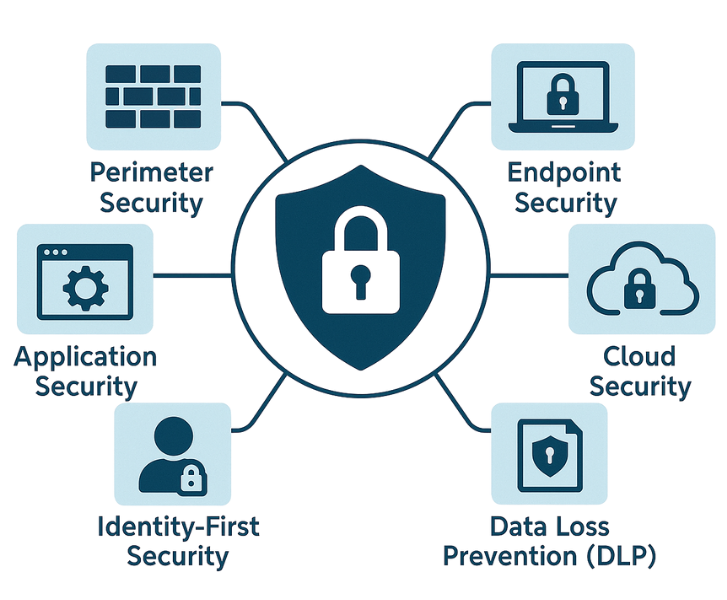
Effective network security encompasses a multi-layered approach, addressing vulnerabilities across endpoints, applications, cloud environments, and the network perimeter. Key measures include:
- Perimeter Security: Protects the network edge from unauthorized access or attacks
- Endpoint Security: Ensures devices connecting to the network are secure
- Application Security: Identifies and mitigates vulnerabilities in software
- Cloud Security: Safeguards workloads and data across public, private, and hybrid clouds
- Data Loss Prevention (DLP): Prevents accidental or intentional data leakage
- Identity-First Security: Continuously validates users and devices before granting access
A layered approach ensures that even if one defense fails, other measures provide protection, making the network more resilient to diverse attack vectors.
Key Benefits of Network Security
Investing in a robust network security strategy yields tangible business and operational benefits. Beyond mitigating cyberattacks, strong network security enables organizations to:
- Minimize operational downtime and financial losses from breaches
- Support regulatory compliance and facilitate audit readiness
- Enhance customer and partner trust
- Provide a secure foundation for digital transformation initiatives
- Improve visibility and control over the organization’s digital environment
In essence, network security has evolved into a strategic investment, influencing business performance, operational continuity, and stakeholder confidence.
Challenges in Network Security Management
Despite its importance, network security is complex and continually evolving. Organizations face several challenges:
- Managing security across hybrid IT and multi-cloud environments
- Combating increasingly sophisticated cyberattacks
- Addressing insider threats and human errors
- Allocating budgets effectively and demonstrating ROI
- Adapting to changing regulatory requirements and compliance frameworks
To overcome these challenges, enterprises must implement a proactive and adaptable security strategy that balances technology, processes, and people.
Common Cyber Threats to Networks
Understanding the threats facing modern networks is essential for building an effective security strategy. Cybercriminals continually evolve their tactics, targeting vulnerabilities in endpoints, applications, cloud services, and human behavior. Some of the most common network threats include:
- Malware and Ransomware: Malicious software designed to disrupt operations, steal data, or encrypt systems for ransom. These attacks can spread rapidly across a network if not contained.
- Phishing and Social Engineering: Attackers trick employees into revealing credentials or sensitive information, often through emails, messages, or phone calls.
- Denial-of-Service (DoS) and Distributed Denial-of-Service (DDoS) Attacks: Attempts to overwhelm network resources, making systems unavailable to legitimate users and disrupting business operations.
- Unauthorized Access and Insider Threats: Employees or third parties intentionally or unintentionally accessing systems or data they shouldn’t, leading to potential breaches or data leaks.
- Advanced Persistent Threats (APTs): Highly targeted, prolonged attacks often orchestrated by sophisticated actors aiming to steal sensitive information or disrupt operations over time.
- IoT and Device Vulnerabilities: As more devices connect to the network, insecure IoT devices can become entry points for attackers.
- Man-in-the-Middle (MITM) Attacks: Attackers intercept communications between users and systems to steal or manipulate data in transit.
By identifying and understanding these threats, organizations can prioritize defenses, allocate resources effectively, and implement proactive monitoring strategies. Awareness of these risks is a critical first step in designing a network security framework that protects both infrastructure and business operations.
AI & Emerging Trends in Network Security
As networks become more complex and threats more sophisticated, organizations are increasingly relying on artificial intelligence (AI) and emerging technologies to stay ahead of attackers. AI and machine learning enable real-time analysis of massive volumes of network data, helping detect anomalies, predict potential threats, and automate responses that would otherwise require human intervention.
One of the most significant trends is the adoption of automated Security Orchestration, Automation, and Response (SOAR) systems, which streamline incident response and reduce mean time to detect (MTTD) and respond (MTTR). By integrating AI-driven tools with traditional security measures, organizations can prioritize high-risk alerts, reduce false positives, and free security teams to focus on strategic initiatives.
Other emerging trends shaping network security include:

- Zero Trust Security Frameworks: Identity-first approaches that continuously verify every user, device, and connection, minimizing lateral movement within networks.
- Secure Access Service Edge (SASE): Combines network security and wide-area networking to provide consistent, cloud-first security for hybrid environments.
- Cloud-Native Security: Protects workloads, applications, and data across multi-cloud infrastructures, addressing configuration errors and mismanaged access.
- Behavioral Analytics: Uses AI to monitor user and device behavior, identifying anomalies that could indicate breaches or insider threats.
- Blockchain-Based Security Solutions: Emerging use cases include ensuring data integrity, secure transactions, and tamper-proof audit trails.
By embracing AI and these emerging technologies, organizations can anticipate threats before they occur, respond faster, and build a resilient security posture that adapts to the evolving threat landscape. In 2026 and beyond, leveraging AI-driven insights and innovative security frameworks will be essential for proactive network defense.
Building a Future-Ready Network Security Strategy
Developing a practical network security strategy for 2026 requires a holistic approach. Organizations must focus on:
- Implementing identity-first security across users, devices, and applications
- Leveraging AI-powered threat detection and automated response mechanisms
- Securing cloud and hybrid infrastructures effectively
- Monitoring and mitigating third-party and supply chain risks
- Continuously measuring effectiveness through detection times, response metrics, and risk reduction scores
By integrating technology, processes, and governance, enterprises can anticipate threats, respond efficiently, and maintain business continuity.
Conclusion
Network security in 2026 is no longer just a technical requirement- it is a strategic guide for resilient, future-ready enterprises. By adopting layered defenses, emerging technologies, and continuous risk assessment, organizations can reduce exposure, strengthen operational resilience, and deliver measurable business value. A well-rounded, forward-looking network security strategy enables confident digital transformation while safeguarding critical assets, reputations, and trust.
To learn how your organization can strengthen network defenses, implement AI-driven security, and adopt emerging frameworks like Zero Trust and SASE, get in touch with our experts today: solutions@progressive.in
Partner with Progressive Techserve to transform your network security strategy into a competitive advantage, protecting your critical assets while enabling secure growth and digital innovation.