
Every managed services provider says it’s “proactive.” Sit in on an actual incident call and the story looks different: an alert fires only after the server’s already down, someone asks why the cloud bill jumped 30%, and a quick check turns up that the last three backups quietly failed.
That gap between the pitch and the practice isn’t a marketing problem. It’s an architecture problem. Most managed IT services, across networks, security, cloud, backups, and compliance, still run on the same underlying logic: wait for something to break, then fix it.
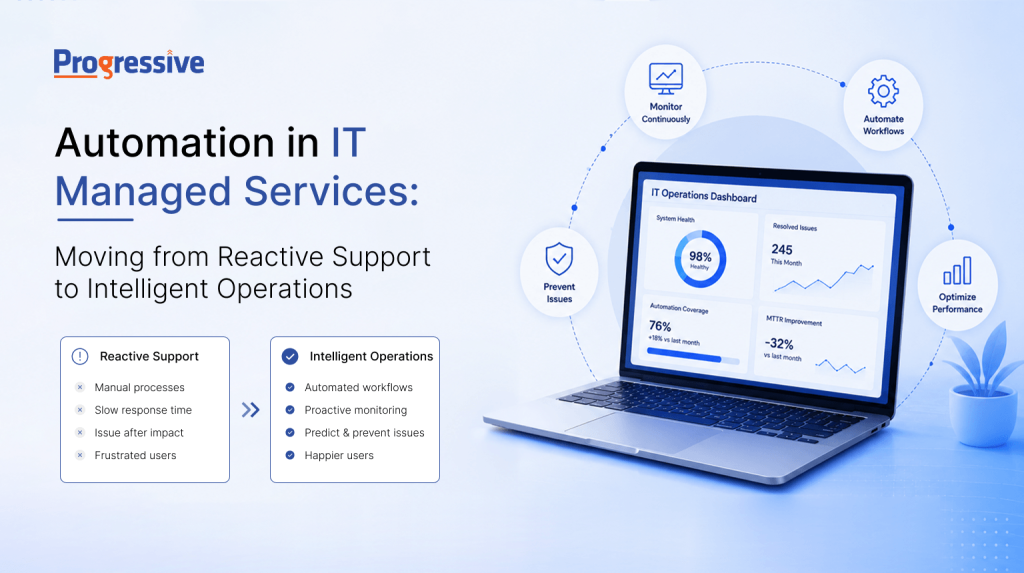
Automation is closing that gap. This blog looks at what that shift actually looks like across the full stack: infrastructure monitoring, cybersecurity, cloud management, backup and continuity, compliance, and IT strategy, and what a genuinely intelligent operations model delivers once it’s running.
Why Reactive Management No Longer Works
Reactive IT assumes someone will notice a problem and report it before it causes real damage. That assumption held up when environments were simpler. It breaks down fast against hybrid cloud workloads, remote endpoints, and a threat landscape that shifts weekly.
That breakdown shows up everywhere once you look for it. Infrastructure issues surface as outages instead of early warnings, because threshold-based alerts lack the context to flag a problem while it’s still developing. Security teams lean on known threat signatures, which miss new or evolving attack patterns until the damage is already done. Cloud spends creeps up as unused instances and oversized workloads go unnoticed between manual reviews, compliance checks happen periodically instead of continuously, leaving gaps where policy drift goes undetected, and capacity planning runs on guesswork instead of usage data, so organizations either overprovision or get caught short during growth.
Each of these gaps costs money, time, or risk. Automation closes them by giving every function of managed IT services the same shift: from responding after the fact to acting before impact.
What Automation Actually Means in Managed IT Services
Automation is not one tool. It is a stack of capabilities that work together across infrastructure, security, and operations.
● Robotic Process Automation (RPA): executes rule-based tasks like patch deployment, provisioning, and routine configuration changes without manual effort.
● AIOps (AI for IT Operations): applies machine learning to monitoring data across network, server, and cloud layers to detect anomalies before they become incidents.
● AI-powered Root Cause Analysis (RCA): correlates signals across systems to identify why an issue occurred, cutting diagnostic time from hours to minutes.
● Predictive analytics: uses historical performance and usage data to forecast capacity needs, security risks, and hardware failures ahead of time.
Together, these layers turn scattered monitoring tools into a single system that anticipates problems across the entire IT estate.
The Automation Maturity Curve: Reactive, Proactive, Intelligent
Stage 1: Reactive Operations
Every function, network, security, cloud, backup, waits for a failure or an alert before anyone acts. Mean Time to Resolution (MTTR) is the primary metric, and teams stay permanently on the back foot.
Stage 2: Proactive Monitoring
Dashboards and threshold-based alerts flag issues before users report them. Visibility improves, but a person still has to interpret every alert and decide what action to take.
Stage 3: Intelligent Operations
Systems correlate data across infrastructure, security, and cloud layers, then predict, auto-remediate, or route issues with full context attached. IT strategy shifts from maintenance to prevention and planning.
Where Automation Is Reshaping Every Layer of Managed IT Services
Automation delivers different value depending on which function of managed IT services it touches. Here is how it plays out across the full stack.
Network and Infrastructure Monitoring
AIOps platforms track performance across servers, network devices, and virtual environments continuously. Instead of static thresholds, machine learning models learn normal behavior and flag deviations early, often before a slowdown becomes an outage.
Cybersecurity and Threat Detection
Signature-based security tools struggle against new attack patterns. AI-driven detection analyzes user behavior, login patterns, and network traffic to catch anomalies that don’t match any known signature, then triggers an automated response before an attacker can move laterally.
Patch and Endpoint Management
Manual patching is slow and inconsistent, and it is one of the most common entry points for breaches. Automated patch management schedules, tests, and deploys updates across every endpoint, whether on-premises, remote, or mobile, without engineers touching each device.
Cloud Resource and Cost Optimization
Cloud environments change by the hour, and manual reviews cannot keep pace. Automation analyzes usage patterns continuously, scales resources up during demand spikes, scales them back down afterward, and flags oversized or idle instances that are quietly driving up cost.
Backup, Disaster Recovery, and Business Continuity
Backup failures are often discovered only during a real recovery attempt, which is the worst possible time. Automated backup validation tests recovery points on a schedule, confirms data integrity, and alerts the team the moment a backup job silently fails.
IT Support and Self-Service
Ticket triage, password resets, and guided self-service resolve routine requests instantly. The real value isn’t the speed for the end user; it’s what that speed frees up. Engineers get their hours back for infrastructure, security, and strategy work instead of repetitive requests.
Compliance and Risk Management
Regulatory requirements do not pause between audit cycles. Automated policy enforcement checks configurations continuously against compliance frameworks, flags drift immediately, and keeps audit documentation current instead of reconstructed under deadline pressure.
Data-Driven IT Strategy and Capacity Planning
Every layer above generates data, performance trends, security events, cloud utilization, ticket patterns. Automation turns that data into forecasts: where capacity will run out, which systems carry the most risk, and where infrastructure investment will pay off first. This is what turns a managed services provider into a strategic partner rather than a support line.
Business Impact: What Leadership Actually Gains
This shift shows up directly in the metrics leadership tracks. Operating costs come down first, since automated cloud optimization and patch cycles cut both cloud spend and manual labor hours. Security posture gets stronger, because behavior-based threat detection catches attacks that signature-based tools miss, reducing dwell time. Uptime improves as predictive monitoring across infrastructure prevents outages instead of just shortening them, and business continuity becomes something leadership can actually rely on, since continuously validated backups mean disaster recovery works when it’s needed.
Compliance stays audit-ready as continuous policy checks close gaps before they turn into findings, and strategic decisions get sharper as data-driven forecasting replaces guesswork in capacity planning and technology investment.
Common Roadblocks (and How to Avoid Them)
None of this happens overnight, and a few obstacles show up predictably. Legacy infrastructure may lack the telemetry automation tools need, so it helps to roll automation out in phases, starting with the most instrumented environments.
Automation is only as good as the data feeding it, which means consolidating monitoring, security, and ticketing data before layering AI on top. Teams used to manual control over infrastructure and security may distrust automated decisions at first, so starting with low-risk, high-volume tasks helps build trust before expanding further. And not everything should be automated: complex, judgment-heavy incidents, major security events, and architecture changes still need an experienced engineer in the loop.
A Practical Roadmap to Intelligent Managed IT Operations
1. Audit performance, security, and support data across the full IT estate to find the highest-risk, highest-volume gaps.
2. Automate the highest-value, lowest-risk tasks first: patch deployment, backup validation, and routine ticket resolution.
3. Deploy AIOps and behavior-based security monitoring for continuous visibility across network, cloud, and endpoints.
4. Layer in AI-powered RCA and predictive analytics so teams spend time preventing issues instead of chasing them.
5. Automate compliance checks and reporting so audit readiness becomes continuous instead of periodic.
6. Feed the resulting data into capacity planning and long-term IT strategy decisions.
Where This Is Headed: Autonomous IT Operations
The next stage beyond intelligent operations is autonomous IT: systems that resolve entire categories of incidents end to end, across infrastructure, security, and cloud, with humans stepping in only for exceptions. Managed IT services providers that build strong automation foundations across every function today will be positioned to adopt this fastest.
Final Thoughts
None of this makes IT support disappear, and it shouldn’t. What it does is put engineers back on the work that needs a human: architecture decisions, security judgment calls, the messy edge cases no model has seen before. Everything else, patching, monitoring, backup checks, cost tuning, gets handled before it ever turns into a fire drill. That’s a better use of a good engineer’s time, and a better outcome for the business paying for it.
Frequently Asked Questions
What does automation cover in managed IT services?
It spans network and infrastructure monitoring, cybersecurity threat detection, patch and endpoint management, cloud cost optimization, backup validation, compliance checks, and IT support.
How is this different from traditional IT monitoring?
Traditional monitoring relies on static thresholds and manual interpretation. Automated, AI-driven monitoring learns normal behavior across systems and flags deviations before they cause downtime or a security incident.
Does automation replace the IT team?
No. It removes repetitive, low-judgment work so engineers can focus on architecture, security strategy, and the incidents that genuinely need human expertise.
Where should an organization start?
Start with the highest-volume, lowest-risk processes, typically patch management, backup validation, and routine ticket triage, then expand into security monitoring and compliance automation as trust in the system builds.