
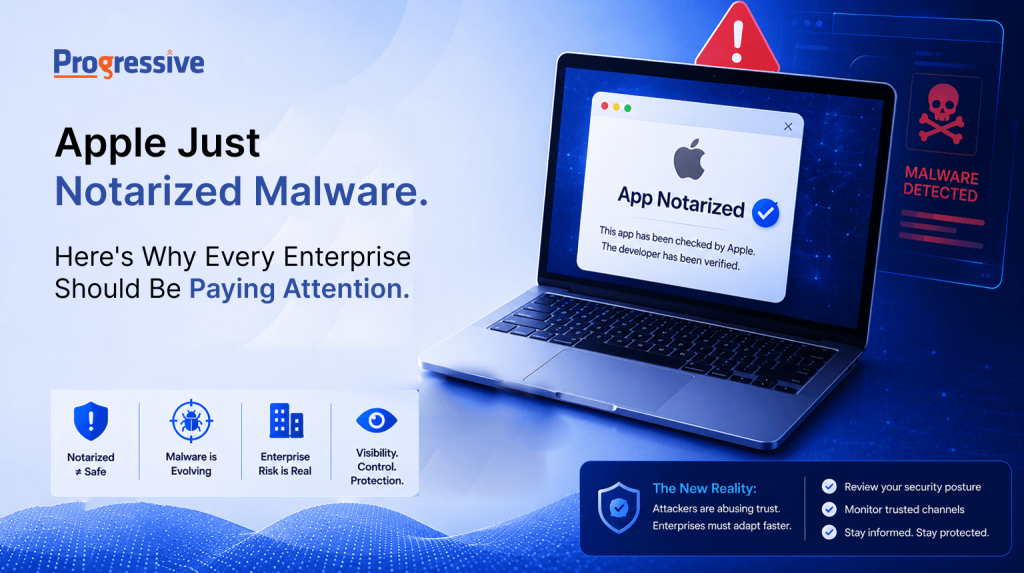
Apple has spent years building one of the strongest software trust models in the industry. If an application is signed by a recognised developer and passes Apple’s notarization process, most users assume it’s safe to run. CrashStealer has challenged that assumption.
The malware didn’t exploit a flaw in macOS. It arrived through a legitimate Apple Developer ID, cleared Apple’s notarization checks and presented itself as a trusted application. That alone should make every IT leader pause.
The story here isn’t that Apple has weak security. It doesn’t. The story is that attackers no longer need to break trust when they can simply borrow it. That’s a much bigger shift, and it isn’t limited to macOS.
CrashStealer in 30 Seconds
If you’ve only seen the headlines, here’s what happened.
CrashStealer:
- Used a legitimate Apple Developer ID.
- Passed Apple’s notarization process.
- Posed as Apple’s Crash Reporter.
- Prompted users for administrator credentials.
- Stole Keychain data, browser credentials, cookies and password vaults.
- Exfiltrated the collected data to attacker-controlled infrastructure.
Those facts matter.
What matters even more is what they tell us about where endpoint security is heading.
Trust Is No Longer Enough
For a long time, endpoint security followed a simple principle. If software came from a trusted source, it was probably safe. That principle still has value, but it shouldn’t be the finish line.
CrashStealer didn’t win because Apple’s security controls failed. It won because it looked trustworthy long enough to convince users and bypass the checks designed to verify software before execution.
That’s an important distinction. Most organisations still spend considerable effort deciding whether an application should run.
Far fewer spend the same effort watching what it does after it starts running. That has to change.
Ask Better Questions
Instead of asking:
Is this application signed?
Start asking:
- What is this application doing?
- Has its behaviour changed since installation?
- Is it trying to access credentials it shouldn’t?
- Is it communicating with destinations we’ve never seen before?
- Would our team notice if it quietly became malicious tomorrow?
Those questions are far more valuable than a digital signature alone.
The Endpoint Is Now an Identity Target
A few years ago, ransomware dominated security conversations because attackers wanted to disrupt operations. Today, many attackers are aiming for something much quieter.
Identity. CrashStealer wasn’t interested in encrypting devices. It targeted the assets that give attackers access to everything else.
Its target list included:
- Apple Keychain credentials
- Browser passwords
- Authentication cookies
- Saved browser sessions
- Password manager vaults
- Cryptocurrency wallets
Think about what those assets represent. A browser cookie might provide access to Microsoft 365. A saved session could open your CRM. A password vault could unlock dozens of business applications. The endpoint is no longer just another device on the network. For many organisations, it has become the front door to the business.
Prevention Alone Won’t Keep Up
Most endpoint security programmes still rely on a familiar mix of controls.
- Code signing
- Reputation scoring
- Allow lists
- Signature-based detection
- Security policies
None of these are obsolete. They’re still essential. The problem is that they’re designed to answer two question:
- “Should this application be allowed to run?” Modern attacks demand a second question.
- “What happens after it’s running?” That’s where many security strategies still have a gap.
Four Capabilities Every Endpoint Strategy Should Prioritise
Incidents like CrashStealer don’t mean organisations need more security tools. They need better operational visibility and faster response.
1. Harden Every Endpoint
Reduce the opportunities attackers have before an attack begins.
Focus on:
- Least-privilege access
- Standard security baselines
- Application control
- Browser hardening
- Continuous configuration compliance
Hardening won’t stop every attack, but it gives attackers far less room to move.
2. Watch Behaviour, Not Just Reputation
Signed software can still behave maliciously.
That’s why behavioural monitoring matters.
Look for signals such as:
- Unexpected privilege escalation
- Unusual Keychain access
- Browser credential harvesting
- Suspicious process activity
- Connections to unfamiliar domains
Behaviour often reveals what reputation cannot.
3. Monitor Continuously
Most organisations already collect endpoint telemetry.
The challenge isn’t visibility.
It’s knowing which events deserve immediate attention.
Continuous monitoring should focus on:
- Endpoint health
- Authentication activity
- Configuration drift
- Application behaviour
- User context
Collecting data is easy.
Turning it into action is the difficult part.
4. Build Operational Readiness
Technology doesn’t contain incidents.
People and processes do.
Make sure your organisation can:
- Investigate alerts quickly
- Validate genuine threats
- Isolate compromised endpoints
- Respond before attackers move laterally
- Learn from every incident
Fast response often matters more than perfect prevention.
Our Perspective
CrashStealer isn’t remarkable because it targeted macOS. It’s remarkable because it reflects where endpoint attacks are heading. Attackers are investing less effort in bypassing security controls and more effort in appearing legitimate.
That’s a strategy we’re likely to see again, regardless of operating system. For security leaders, the takeaway is simple. Don’t stop trusting software. Stop assuming trust is permanent.
Trust should be earned continuously through observed behaviour, not granted indefinitely because an application passed a check once.
Over to You
If a signed, notarized application landed on one of your managed endpoints tomorrow and quietly began harvesting credentials, how quickly would your team know?
Would your current endpoint strategy detect the behaviour, or would it rely on the assumption that trusted software remains trustworthy?
I’d be interested to hear how other IT and security leaders are approaching this. Has your organisation already shifted towards behaviour-based endpoint security, or is prevention still the primary focus?
Progressive Techserve helps enterprises strengthen endpoint resilience through endpoint hardening, managed endpoint security and continuous security operations. As attacks continue to evolve, our focus remains the same: helping organisations reduce risk before incidents become business disruptions.